Disclosure: this guide contains referral links, marked where they appear. All prices are independently measured from public data on the dates shown.
The 25-year rule is the sentence of federal law that makes the entire kei truck hobby possible, and the most misquoted one. This page explains it for kei trucks and vans specifically; the mechanics apply to any JDM import, but the examples, prices and unlock calendar here are kei. The rule runs on build months, not model years; it exempts you from safety standards, not from the 25% duty and not from your state’s registration rules; and as of August 2026 it admits any kei vehicle built through roughly August 2001, with a new month’s production unlocking every month. This page explains how the clock actually works, what unlocks between now and 2030, and the measured-data reason newly-eligible trucks are consistently the best deals in the market.
I research Japan’s used vehicle market from Sapporo. This is the legal-mechanics companion to the step-by-step import guide.
The Rule in One Paragraph
US law (49 USC §30112, administered by NHTSA) requires imported vehicles to meet Federal Motor Vehicle Safety Standards — crash structures, airbags, the works — which no kei truck was ever built to. The exemption: a vehicle 25 years or older from its date of manufacture is excused from FMVSS entirely and can be imported without modification or a Registered Importer. The federal government’s logic is that a 25-year-old vehicle is a collector item, not daily transportation. That one carve-out is the legal foundation under every kei truck on American soil.
Where the number comes from: the Imported Vehicle Safety Compliance Act of 1988 closed the old gray-market import channels and created the 25-year exemption as the collector-car escape valve. It was written with European classics in mind; nobody in 1988 was thinking about Japanese farm trucks. Thirty-odd years later, the kei truck boom is the law’s most productive unintended consequence — and because the exemption is statutory rather than an agency policy, it does not shift with administrations the way tariff schedules do.
The Two Clocks: NHTSA’s 25 Years and the EPA’s 21
Two agencies run two separate clocks, and you need both to have expired:
- NHTSA (safety): 25 years from date of manufacture. Declared on Form HS-7 at entry.
- EPA (emissions): 21 years from date of manufacture. Declared on Form 3520-1 at entry.
One caveat on the EPA side: the exemption assumes the vehicle still carries its original engine or an equivalent — an engine-swapped vehicle complicates the emissions declaration. Because 25 is longer than 21, the NHTSA clock is the binding one in practice — by the time a kei truck clears safety, it cleared emissions four years earlier. Both forms are still filed at the port; your customs broker handles them as routine paperwork, as covered in the import guide.
Build Month, Not Model Year — the Expensive Distinction
Eligibility turns on the month stamped on the vehicle, and NHTSA does not round up. A truck built in June 2001 is eligible in June 2026; import it in May and it is subject to seizure and re-export at your expense. Two documents answer the question definitively:
- The caution plate (compliance plate) riveted to the firewall or door jamb, which lists the build date — this is what NHTSA references.
- The Japanese export certificate, which lists the date of first registration — normally within a few months of build and the document your exporter provides as part of the sale.
Model years mislead in both directions: Japanese production for a new model year often starts months before the calendar year, so a “2001” truck may have been built in October 2000 (eligible earlier than you thought) — or a “2000” truck registered late may have left the line in January 2001 (eligible later). The auction sheet guide covers where registration dates appear in auction paperwork; the caution plate settles anything the paperwork leaves fuzzy.
What Is Eligible Right Now
As of August 2026: everything built through roughly August 2001. In kei truck terms, that means the full classic generations of all five models — round-headlight Carries, second-generation Actys, KS-series Sambars — plus the first two to three years of the platforms introduced in 1999: Acty HA6/HA7, Sambar TT1/TT2, Hijet S200P/S210P, Minicab U61T/U62T, Carry DA52T/DB52T and Every DA52V. Each model’s eligible generations, with measured Japanese prices, live in its own guide: Carry, Acty, Sambar, Hijet, Minicab and Every.
The Unlock Calendar: What Arrives Between Now and 2030
Because the rule rolls monthly, the interesting question is never “is it legal” but “when does the thing I want unlock.” The next several years bring real hardware:
| Unlocking | Vehicle | Why it matters |
|---|---|---|
| Late 2026 onward | Suzuki Carry DA62T / Every DA62V (K6A era) | The K6A engine arrives: chain-driven instead of belt, and in the Every, the factory turbo US build threads chase — the two-turbo-eras story |
| 2027 | Suzuki Carry DA63T (early builds) | The long-running modern Carry begins trickling in |
| 2027–2029 | More HA6/HA7 Actys, TT Sambars, S200/S210 Hijets, U61/U62 Minicabs | The 1999-era platforms complete their unlock, deepening supply every month |
| 2030 | Suzuki Every DA64V | The most camper-friendly Every generation starts arriving |
Calendar rows simplify to years; individual vehicles unlock on their exact build month. If a specific truck is your target, work from its caution-plate date.
How Much Is Actually Coming: the Pipeline, Counted
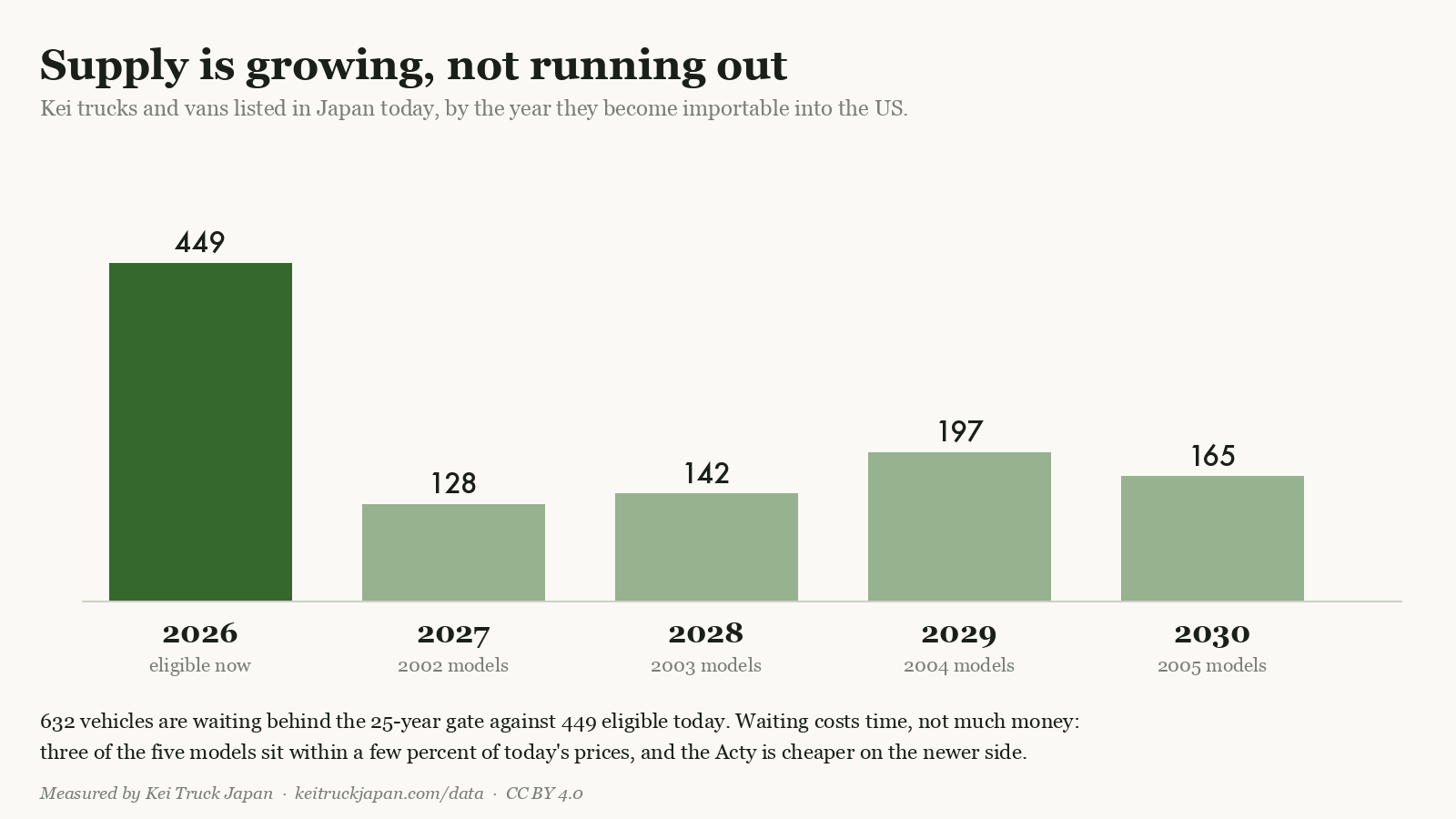
Everyone writing about the 25-year rule describes which models unlock. Nobody counts how many. So on August 19, 2026 I counted the vehicles sitting in Japan’s public market right now that are not yet eligible — the 2002 to 2005 stock waiting for its birthday.
| Model year | Unlocks in | Listed in Japan today |
|---|---|---|
| 2002 | 2027 | 128 |
| 2003 | 2028 | 142 |
| 2004 | 2029 | 197 |
| 2005 | 2030 | 165 |
| Total waiting | 632 | |
Put that next to what is eligible today — 449 trucks and vans across the whole class — and the picture changes. The pipeline behind the gate is larger than the pool in front of it. Supply is not running out; it is growing.
By model, the deepest pipelines are the Carry (189 waiting) and the Hijet (151), followed by the Sambar (141), Minicab (81) and Acty (70). The Acty’s number is the smallest for a structural reason: Honda stopped building it in 2021, and the second-generation trucks Americans favour are already through the gate.
Does waiting cost you money?
This is the question the counting was for. If newer trucks were dramatically more expensive, waiting would be a bad trade. Measured, they are not:
| Model | Eligible now (2001 and older) | Waiting (2002–2005) |
|---|---|---|
| Suzuki Carry | ¥399,000 | ¥450,000 |
| Daihatsu Hijet | ¥453,000 | ¥448,000 |
| Subaru Sambar | ¥364,000 | ¥450,000 |
| Mitsubishi Minicab | ¥394,000 | ¥390,000 |
| Honda Acty | ¥398,000 | ¥380,000 |
Median asking prices, measured the same day. Three of the five sit within a few percent of today’s eligible stock, and the Acty is actually cheaper on the newer side — four years newer for ¥18,000 less. Only the Sambar carries a real premium, and that traces to the supercharged and Dias trims that cluster in those years rather than to age itself.
The practical read: waiting for a specific newer model costs you time, not much money. If the DA63T Carry or a late Hijet is what you actually want, the pipeline is deep and the price is not running away from you. What you give up is the mispricing described above — the discount that exists precisely because a truck has just become eligible and Japanese sellers have not repriced it.
All of it is downloadable: the raw dataset has one row per vehicle, so you can recount any of this yourself.
Why Newly-Eligible Trucks Are the Best Deals — Measured, Not Theorized
The legal explainers stop where the money starts, because the next part takes price data to see. I measure Japan’s complete public inventory of eligible kei vehicles across this site, and on four separate models the same pattern appears: the newest importable generation is priced below the older one in Japan. Measured medians, August 2026: the Acty’s newly-unlocked third generation lists under its second (¥385,000 vs ¥400,000); the Sambar’s TT era under its KS era (¥360,000 vs ¥390,000); the Carry’s DA52 era under its round-headlight era (¥385,000 vs ¥400,000); and the Every’s DA52V at just over half its older sibling’s price (¥300,000 vs ¥550,000).
The mechanism is simple: Japanese sellers price age, because inside Japan a 1999 work van is just an older work van. American demand prices the import calendar — newest-eligible is most desirable. Nobody on the selling side adjusts for a US law they have no reason to know exists, so every month the rolling calendar quietly restocks the bargain shelf. This is the practical reason to understand the rule rather than just obey it: the 25-year rule doubles as a price signal. Buyers who track build months capture the discount first, before US-side demand catches up with each newly-unlocked cohort.
What the Rule Does Not Do
- It does not waive the duty. The 25% truck tariff (and the smaller federal fees) apply in full — the cost guide itemizes them. The 2025 Section 232 auto tariff does exempt 25-year-old vehicles, but the classic chicken tax stands.
- It does not register your truck. Federal eligibility gets the vehicle into the country; plates are state law, and states range from ordinary registration to outright refusal — mapped in the 50-state legality guide.
- It does not inspect anything. The exemption waives standards; it does not certify condition. A legally importable truck can still be a rust bucket, which is why most buyers should spend more time on the auction sheet than on the statute.
Verify Before You Buy
The eligibility check is a two-minute discipline, in order:
- Ask for the caution-plate build date — a photo of the plate itself, not a transcription. This is the date NHTSA references.
- Cross-check the export certificate’s first-registration date. It normally sits within a few months of build; a large gap is a question worth asking.
- Add 25 years and compare to your shipping schedule, not today’s date — the truck must be 25 when it arrives, and the crossing takes weeks.
Treat any listing that offers a model year but no build month as unverified. Reputable agents and exporters confirm eligibility as a standard part of the service, because a seized vehicle at the port costs everyone.
Once the calendar clears your target, the rest is shopping: CAR FROM JAPAN lists thousands of eligible kei trucks and vans with year filters, so you can browse exactly the cohort the rule just unlocked. My referral code takes $100 off a first purchase — create a free account, enter KEITRUCK at the order step.
Browse eligible kei trucks at CAR FROM JAPAN — $100 off with code KEITRUCK
You save $100; I earn a referral reward. Every price in this article is measured independently of them.
FAQ
Is my truck eligible? The fast answer.
Take the build month from the caution plate and add 25 years. If that date is in the past, it is federally eligible today; if not, that date is your unlock day. Model year alone cannot answer the question.
Can I buy a truck now and import it when it turns 25?
Yes — buying in Japan and holding until eligibility is an established tactic for chasing a specific soon-to-unlock vehicle, and some exporters offer storage for exactly this. You pay storage and you tie up money early, but for rare configurations (a specific K6A turbo Every, say) it beats hoping one surfaces later.
What happens if a vehicle arrives before its 25th birthday?
Customs can seize it, and the importer re-exports it at their own cost. NHTSA does not round up, grant grace periods, or accept “the model year says 2001.” This is the one mistake in the process with no cheap fix — verify the build month before money moves.
Does the 25-year rule make kei trucks street legal?
Federally importable, yes; street legal, that depends on your state. Eight states register kei trucks like ordinary vehicles, thirteen refuse road use, and most of the rest allow them with conditions — the full 50-state map has the current status of each.
Do kei vans and kei cars follow the same rule?
Yes — the exemption is about age, not body style. The practical differences show up elsewhere: vans can raise a passenger-vs-cargo duty classification question at customs, and a few states treat passenger kei vehicles differently at registration.
Can a newer kei truck come in under “Show or Display”?
Realistically, no. The Show or Display exemption is a narrow NHTSA program for historically or technologically significant vehicles, granted case by case with a 2,500-mile annual cap — mass-produced work trucks are not what it exists for. For a kei truck under 25, the honest options are: wait, or buy it in Japan and store it until its birthday.
Is there a 15-year rule like Canada’s?
Not in the US. Canada admits vehicles at 15 years, which is why newer kei trucks appear on Canadian roads long before American ones. For US buyers the number is 25, with no shortcut — the vehicles you see landed earlier in Canada become your preview of what unlocks here a decade later.