Last verified August 2026 against state statutes, bill trackers and DMV publications. Laws in this space change fast — several states moved in the last 24 months — so treat this page as your map and your own DMV as the final word.
Are kei trucks street legal in the US? Federally, yes — any kei truck 25 years or older imports legally. Whether you can register and drive it is a state question, and the honest national picture as of August 2026 looks like this: 8 states register kei trucks like any other vehicle, 13 states refuse road use entirely, 26 states allow them with real conditions (speed-limited roads, no interstates, county opt-ins), and 3 states have no clear rule at all. This page maps all 50, explains the fine-print traps that catch buyers, and lists the states that changed their minds most recently — because more of them have moved in the last two years than in the previous ten.
I run the measured-data import guides on this site from Sapporo; this page is the legal companion to the import guide and the cost breakdown.
The Two-Layer System (Where Most Confusion Starts)
Two separate governments have to say yes, and they answer different questions:
- Layer 1 — Federal (importing it): NHTSA’s 25-year rule exempts vehicles 25 years or older from FMVSS safety standards, and the EPA applies a 21-year exemption on the emissions side. Clear both ages — every 25-year-old kei truck does — and the truck enters the country legally. No state can stop the import itself.
- Layer 2 — State (driving it): titles, registration and road use are state law. This is where the 50 answers diverge, and where guides that say “kei trucks are legal now!” quietly stop being useful.
Owning a kei truck is legal everywhere; the 50 answers below are about plates and public roads.
If you have not decided on a truck yet, the Japanese mini truck overview covers what they cost landed and who they suit before you check whether your state will plate one.
How to Read the Table
We use four categories, defined tightly, because loose definitions are how other lists mislead:
- Full registration — the state titles and registers a kei truck like an ordinary vehicle, with no kei-specific road-class or speed-cap statute. (Note: even here, most states other than Texas keep 25+ year imports off interstates in practice; we did not count that alone as a restriction, or nearly every state would be “conditional.”)
- Conditional — road use is allowed but bounded by statute: roads posted under 35–55 mph, no controlled-access highways, county/city opt-in schemes, or special vehicle classes borrowed from golf-cart law.
- No road use — the state refuses on-road registration outright, or routes kei trucks into off-road/OHV titles that explicitly prohibit public roads.
- Unclear — no statute and inconsistent outcomes between DMV offices; sources genuinely disagree.
Basis column: “statute/bill cited” means the classification rests on a specific state statute or bill we could name; “cross-checked” means it rests on agreement between the most rigorous published state-by-state reviews, re-checked in 2026. Where our sources conflicted, we say so in the row rather than picking a side quietly.
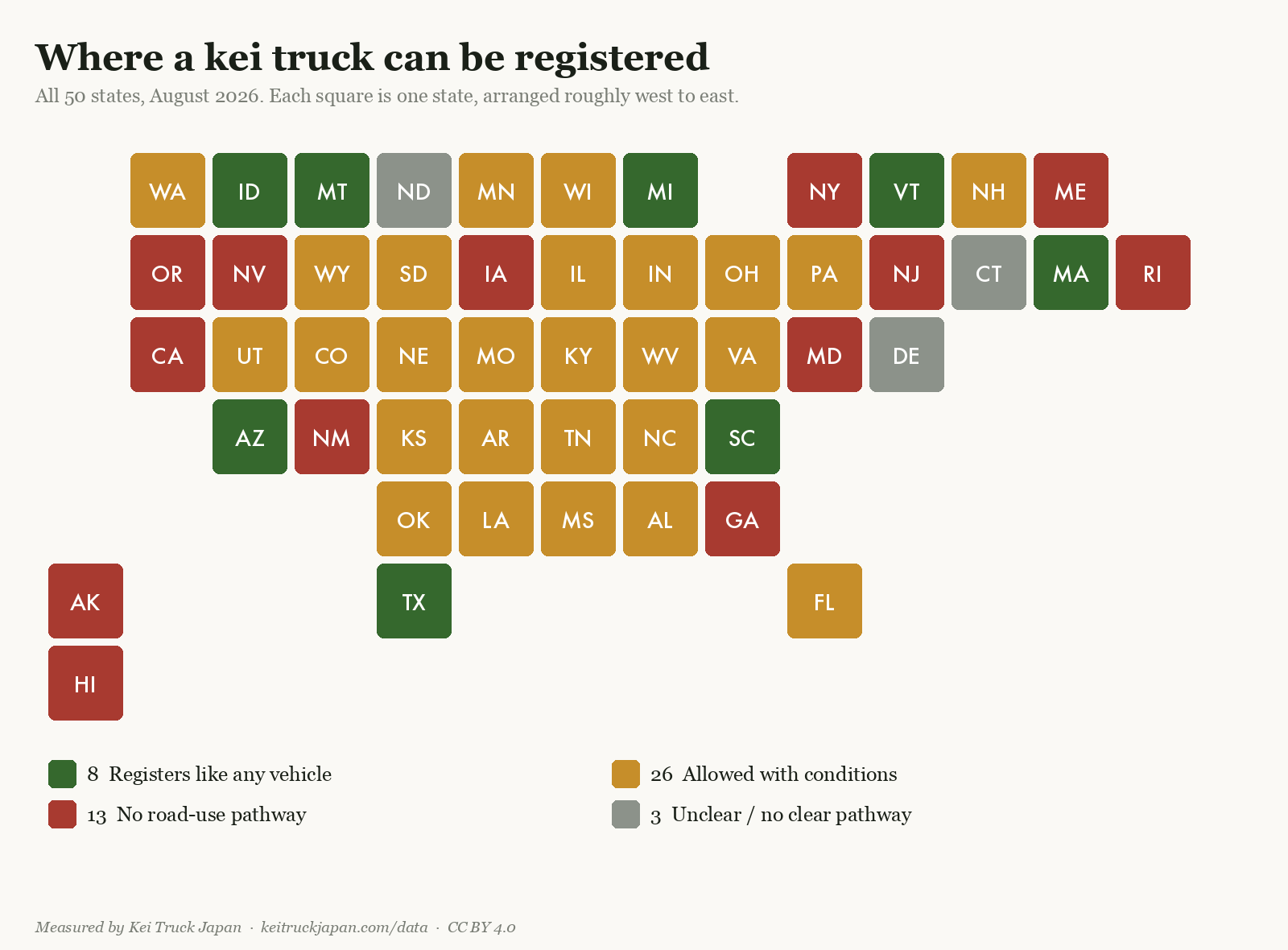
All 50 States, August 2026
| State | Status | What it means in practice | Basis |
|---|---|---|---|
| Alabama | Conditional | Two routes. Mini-truck plate $23: installed 25 mph governor, no interstates, no title issued. Or title and register as a 25-model-year import under Ala. Admin. Code r. 810-5-75-.03(5). Mini-truck definition sets a 1,500 lb floor a light Carry misses. | state rule + ALDOR memo |
| Alaska | No road use | DMV limits imported mini trucks to off-road/private use only | cross-checked |
| Arizona | Full registration | Standard title/registration; no kei-specific restriction. Emissions testing applies in metro Phoenix and Tucson (full guide) | statute cited |
| Arkansas | Conditional | Class 8 farm-vehicle registration; roads <=55mph, no interstates | cross-checked |
| California | No road use | Requires FMVSS or CA emission compliance; the DMV manual bars registration for on-highway and off-highway use (detail) | cross-checked |
| Colorado | Conditional (from 2028) | HB25-1281 (signed 5/9/25): roads <=55mph, no limited-access hwy; registration opens 1/1/2028 | statute/bill cited |
| Connecticut | Unclear | No statute; DMV decides case-by-case, sources disagree legal vs unclear | cross-checked |
| Delaware | Unclear | No statute or confirmed pathway; outcomes vary by office | cross-checked |
| Florida | Conditional | Fla. Stat. 316.2122: roads posted <=35mph only | statute/bill cited |
| Georgia | No road use | Policy Bulletin MVD-2023-05 bans titling, revokes existing titles; fix bill HB 308 vetoed 2025 (full guide) | statute/bill cited |
| Hawaii | No road use | HRS §286-42 bars non-FMVSS vehicles — but excepts special interest vehicles, defined without an age limit. County-administered, four different answers (full guide) | cross-checked |
| Idaho | Full registration | No kei-specific restriction; standard registration | cross-checked |
| Illinois | Conditional | SoS refuses registration under 625 ILCS 5/3-401(c-1)(1); title branded “Not Eligible For Registration” (full guide) | cross-checked |
| Indiana | Conditional | BMV mini-truck title; all public roads except interstates; 1,600 lb weight cap (full guide) | cross-checked |
| Iowa | No road use | Iowa Code 321.30: FMVSS label required; registration refused any age | statute/bill cited |
| Kansas | Conditional | KSA 8-15,106: city/county ordinance opt-in; no highways | statute/bill cited |
| Kentucky | Conditional | SB63 (eff. 6/27/25): county opt-in special-purpose vehicle; no interstates, 20-mi cap | statute/bill cited |
| Louisiana | Conditional | La. RS 32:299.2: roads <=55mph; no interstates/controlled-access | statute/bill cited |
| Maine | No road use | Registrations halted 2023 and existing ones cancelled (29-A §354). A seven-member state working group — including a foreign car importer — recommended no change, unanimously (Feb 2026); SP884 then failed 4/29/26 (full guide) | cross-checked |
| Maryland | No road use | Widely reported as refused, but the MVA’s overseas-vehicle instructions accept HS-7 box 1; likely gate is the “non-conforming” rule (full guide) | cross-checked |
| Massachusetts | Full registration | RMV resumed registering kei vehicles 9/18/24 after brief halt; agency policy, safety study still unpublished (full guide) | cross-checked |
| Michigan | Full registration | SOS dropped off-road-only stance 11/2024; issues standard on-road titles (full guide) | SOS FAQ quoted |
| Minnesota | Conditional | §169.011 subd.40a defines mini trucks and requires non-FMVSS manufacture; road use needs a local ordinance and an individual permit with a sheriff’s inspection (full guide) | statute/bill cited |
| Mississippi | Conditional | Titled as standard truck; operation limited to roads <=35mph | cross-checked |
| Missouri | Conditional | Titles as “Non-USA-Std Motor Vehicle” via MSHP Form 551 examination. The §304.032 municipal route is for utility vehicles, defined as manufactured exclusively for off-highway use (full guide) | cross-checked |
| Montana | Full registration | No kei-specific restriction; permanent plates on 11+ yr vehicles | cross-checked |
| Nebraska | Conditional | Mini-truck title; no interstates, expressways or freeways; lights-on required; best-drafted definition in the country (full guide) | cross-checked |
| Nevada | No road use | DMV routes to OHV-only registration; explicitly bars all public-road use | cross-checked |
| New Hampshire | Conditional | RSA 259:50-a: roads <=35mph; 25-mile radius for commercial use | statute/bill cited |
| New Jersey | No road use | MVC requires full FMVSS/EPA compliance; no registration pathway | cross-checked |
| New Mexico | No road use | MVD applies FMVSS/equipment rules that exclude kei trucks | cross-checked |
| New York | No road use | DMV will not register/title without FMVSS/EPA compliance as originally built (full guide) | DMV page quoted |
| North Carolina | Conditional | G.S. 20-121.1: roads posted <=55mph (a posted-speed rule, not a road-class rule); no antique plates (full guide) | statute/bill cited |
| North Dakota | Unclear | No statute; some owners report <=55mph registration in practice — call your county first | cross-checked |
| Ohio | Conditional | ORC 4511.214/215: local-ordinance opt-in required; roads posted <=35mph. Definition (4501.01) requires non-FMVSS manufacture (full guide) | statute/bill cited |
| Oklahoma | Conditional | 47 O.S. 1151.3: roads <=55mph; no interstates | statute/bill cited |
| Oregon | No road use | DMV will not title or register; the Class IV ATV route it names was narrowed by a 2023 amendment. HB 4063 died at the 2/16/26 policy deadline (2nd failed try) and defined a kei truck at 11 ft = 132 in (full guide) | DMV page + statute quoted |
| Pennsylvania | Conditional | Off-road/farm/antique titles only since Dec 2021; HB1205 stalled since 2025 (full guide) | statute/bill cited |
| Rhode Island | No road use | H8013 ended new registrations 6/1/24; ~30 grandfathered units capped <=35mph | statute/bill cited |
| South Carolina | Full registration | No kei statute, no periodic safety inspection, no restricted road class; 5% Infrastructure Maintenance Fee capped at $500 (full guide) | cross-checked |
| South Dakota | Conditional | Registered under street-legal UTV class; roads <=65mph; no interstates | cross-checked |
| Tennessee | Conditional | TCA 55-1-125 names mini-trucks and covers petrol vehicles. Two routes: medium speed (streets <=40mph, but the truck must be limited to 35mph, certified under perjury) or Class I OHV (full speed, county roads, nonhighway tyres) (full guide) | statute/bill cited |
| Texas | Full registration | SB1816 (eff. 6/20/25): new “miniature vehicle” class, titled and registered as a motor vehicle; no road-class or speed cap, but operation requires the vehicle be capable of complying with traffic laws | statute/bill cited |
| Utah | Conditional | Widely reported as roads <=50mph, no interstates — but the statutory route is unverified: Utah’s ATV definitions require low-pressure tyres/ROPS/recreational design (full guide) | cross-checked |
| Vermont | Full registration | S.326 signed 6/16/26, eff. 7/1/26: standard registration, no special speed cap | statute/bill cited |
| Virginia | Conditional | LSV route is closed: DMV requires manufacturer certification of 49 CFR 571.500 conformity (VLIC-3.205 rev. 7/1/23). HB219 would create a proper kei class on Colorado’s template; died in subcommittee 2026 (full guide) | cross-checked |
| Washington | Conditional | Reported as LSV framework at <=35mph, but every low-speed class in WA statute is electrically powered and the WATV class requires handlebars — no class obviously fits a petrol kei truck (full guide) | cross-checked |
| West Virginia | Conditional | Special Purpose Vehicle (17A-13-1): no controlled-access roads; 20-mi cap | statute/bill cited |
| Wisconsin | Conditional | §341.10(6) names kei vehicles and refuses ordinary registration; NON USA STANDARD title brand, collector plates only — 2x the annual fee, a second registered vehicle required, void every January (full guide) | statute/bill cited |
| Wyoming | Conditional | Multipurpose-vehicle class; all roads except interstates | cross-checked |
The States That Just Changed — and Which Way
The last 24 months moved more states than the previous decade, in both directions. If your information predates these, it is wrong:
| State | When | What happened |
|---|---|---|
| Vermont | July 1, 2026 | S.326 took effect: standard registration, no special speed cap — the newest full-registration state |
| Oregon | March 2026 | Legalization bill HB 4063 died in committee — another failed attempt; no road path remains |
| Maine | April 2026 | Follow-on bill SP 884 failed; the 2023 registration halt stands |
| Texas | September 1, 2025 | SB 1816 made kei trucks ordinary motor vehicles statewide — no road-class limits, the most open state in the country |
| Kentucky | June 2025 | SB 63 created a county opt-in special-purpose class — progress, but your county must say yes |
| Colorado | May 2025 | HB25-1281 signed: roads under 55 mph allowed — but registration only opens January 1, 2028 |
| Georgia | 2023–2025 | Revenue bulletin MVD-2023-05 banned titling and began revoking existing titles; the 2025 fix bill was vetoed |
| Michigan | November 2024 | Secretary of State dropped its off-road-only stance; standard on-road titles now issue |
| Massachusetts | September 2024 | RMV resumed registration after a brief halt |
| Rhode Island | June 2024 | H 8013 ended new registrations; roughly 30 grandfathered trucks remain, capped to 35 mph roads |
Both directions carry a lesson, and the wins came two different ways. Texas, Vermont, Colorado and Kentucky changed by statute, after owner groups pushed legislation. Michigan and Massachusetts changed administratively — the agency simply reversed its own classification, with Michigan telling affected registrants the earlier off-road treatment had been an error. That distinction matters if you are lobbying: an administrative position can move without a bill. Meanwhile the losses (Georgia, Rhode Island, Maine, Oregon’s failed bills) show that no state’s status is permanent in either direction. If your state sits in the hostile column, the Texas and Vermont playbooks are being copied by owner associations in several legislatures right now; if it sits in the full column, register promptly rather than assuming the window stays open forever — Georgia’s title revocations reached owners whose trucks had been titled and driven legally for years.
The Fine-Print Traps
Across state lines the same structural traps repeat, and they catch buyers more often than the outright bans do:
- An off-road title means no road use, full stop. Alaska, Nevada, California and others will happily issue an OHV/off-highway title. That document explicitly prohibits public-road use. Lists that count these states as “legal with restrictions” are describing a farm implement, not a truck you can drive to town.
- County opt-in means your county, not your state. Kentucky, Kansas, Ohio, Missouri, Minnesota and parts of Illinois delegate the decision to local ordinance. The state column can say yes while every county around you says nothing — which is a no.
- “Farm use” exceptions are narrow. Arkansas’s Class 8 registration or Pennsylvania’s farm titles cover agricultural movement, not commuting. Buying under a farm exception for daily driving is how trucks get impounded. Pennsylvania’s form asks for the tax filings that prove you farm — the Pennsylvania guide walks through what each route actually permits.
- Grandfather clauses have dates. Rhode Island’s surviving trucks were registered before June 2024; Pennsylvania’s unrestricted titles trace to letters issued before December 2021. If a seller waves a “registered in-state!” title, check whether that status transfers to you — in grandfather states it usually does not. Georgia goes further and cancels titles it already issued, which makes an in-state title there worth less than the truck.
- Some states borrowed golf-cart law. Virginia, Washington and New Hampshire route kei trucks through low-speed-vehicle classes written for 25-mph neighborhood carts — so a truck that cruises at 55 gets legally confined to 35-mph roads regardless of what it can do.
- Watch the length number in your state’s definition. Pennsylvania and North Carolina both define a mini truck as 660cc or less with an overall length of 130 inches or less, and Massachusetts’ pending bill H.4053 would adopt the same figure — and 130 inches is 3,302 mm, which is the Japanese kei length limit as it stood until October 1998. Every kei truck built from 1999 measures 3,395 mm (133.7 in) and is therefore 3.7 inches outside that definition on paper. It is the same template in both states, so check the figure in yours: the North Carolina guide works through what it means where the class actually grants road use, and the Pennsylvania guide where it does not. All three state templates are compared here.
- Others have no class to borrow. New York is the clearest case: too heavy and too road-built to be an ATV under its own statute, and not FMVSS-certified enough to be a car. The truck falls between two definitions rather than failing either one on the merits.
Before You Buy: the 15-Minute Check
Do this in order, before money moves — it is the highest-value quarter hour in the whole import process:
- Search your state’s statute from the table above (or the bill number in the changes table) and read the actual text — it is usually two paragraphs.
- Call your county titling office, not just the state DMV hotline, and ask specifically: “Will you issue an on-road title and registration for a 1998 Japanese kei truck imported under the 25-year rule?” Get the answer in writing or an email if you can.
- In opt-in states, ask your county clerk whether an enabling ordinance exists. If they do not know what you mean, it probably does not.
- Confirm insurance before the truck ships — carriers write kei policies routinely (the cost guide covers typical rates), but confirming beats assuming in restricted states.
If your state comes back green, the rest of the process is logistics: the cost guide shows every dollar, the five-model comparison helps you pick the truck, and the import guide walks the paperwork. If you already know your model, CAR FROM JAPAN lists live inventory — my referral code KEITRUCK takes $100 off a first purchase (referral link).
Sources and How This Page Was Verified
Classifications were compiled in August 2026 by cross-checking the most rigorous published state-by-state reviews against state statutes, bill trackers and DMV publications, with individual re-verification of every state that changed course in 2024–26. Federal layer: NHTSA’s importation rules (nhtsa.gov/importing-vehicle, 49 CFR 571.7) and the EPA’s 21-year exemption. State-layer documents cited in the table, findable verbatim on each state’s legislature or revenue site: Texas SB 1816 (89th Legislature); Vermont S.326 (2026); Colorado HB25-1281; Kentucky SB 63 (2025); Rhode Island H 8013 (2024); Georgia Department of Revenue Policy Bulletin MVD-2023-05 and HB 308; North Carolina G.S. 20-121.1; Florida Stat. §316.2122; Iowa Code §321.30; Kansas KSA 8-15,106; Louisiana RS 32:299.2; Minnesota Stat. §169.045; New Hampshire RSA 259:50-a; Ohio ORC §4511.215; Oklahoma 47 O.S. §1151.3; Tennessee TCA §55-1-125; West Virginia §17A-13-1; Wisconsin §341.10(6); Pennsylvania HB 1205 (pending); Oregon HB 4063 (failed 2026); Virginia HB 219 (failed 2026); Maine SP 884 (failed 2026). Rows marked “cross-checked” rest on agreement between independently maintained reviews re-verified in 2026 rather than on a statute we could name — which is also an honest admission that a handful of states run on DMV practice, not written law.
FAQ
Are kei trucks legal in the US at the federal level?
Yes. A kei truck 25 years or older (by build month) imports legally under NHTSA’s 25-year exemption, and the EPA’s 21-year rule clears emissions. The federal government decides whether it can enter the country; your state decides whether it gets plates.
What are the best states to own a kei truck?
Texas is the most open: SB 1816 created a “miniature vehicle” class that is titled and registered as a motor vehicle, with no road-class or speed cap written into the statute — the only operating condition is that the vehicle be capable of complying with the traffic laws on the road you are using. Vermont (as of July 2026), Michigan, Massachusetts, Arizona, Idaho, Montana and South Carolina also register them without kei-specific restrictions. In those states a kei truck out-drives a side-by-side on public roads, which is the reversal most buyers do not expect — see the kei truck vs UTV comparison.
Is California ever going to allow kei trucks?
Nothing suggests it soon. California requires FMVSS or California emission compliance regardless of age, and its DMV procedures manual states that vehicles which cannot be converted may not be registered for on-highway or off-highway use — the California guide quotes the manual directly. The legislative energy is currently in states like Pennsylvania and Virginia, where owner groups have active bills.
My state says “legal” on other lists but the DMV refused me. Why?
Usually one of the traps above: an opt-in state where your county never opted in, an off-road title being counted as “legal,” or a list that never updated after your state changed course (Georgia and Rhode Island still show as legal on several popular lists). The statute text and your county office outrank any list — including this one.
Can my state take my registration away later?
It has happened — Georgia revoked existing titles from 2023, and Maine halted renewals. It is rare, it triggers owner-group lawsuits and legislation, but it is not hypothetical. The practical mitigation is registering promptly, keeping records, and joining your state’s owner association, because organized owners are the reason Texas and Vermont flipped.
Do these rules apply to kei vans and kei cars too?
Mostly yes — the statutes overwhelmingly regulate by vehicle class (“mini truck” or dimensions/engine size), which catches kei vans as well. A handful of states treat passenger-configured kei vehicles differently; the same 15-minute check answers it for your state.