Disclosure: this guide contains referral links, marked where they appear. All prices are independently measured from public data on the dates shown.
Every “best kei truck” article on the internet ranks the same five trucks with the same adjectives and no numbers. This one has numbers. On August 18, 2026 I measured every 25-year-eligible kei truck publicly listed for sale in Japan — all 394 of them across the five badges — and pulled the real US sale averages for each model the same day. The short answer: the Suzuki Carry is the best kei truck for most buyers, and the Subaru Sambar is the best deal in the class — it has the lowest measured price in Japan and the highest average sale price in the United States.
I research Japan’s used vehicle market from Sapporo. Below is the full comparison: what each truck actually costs on both sides of the Pacific, what each one is genuinely good at, and a straight verdict for every use case — plus links to the deeper guides on this site when one model deserves a longer look.
The 60-Second Verdict
- Best overall: Suzuki Carry. The biggest parts ecosystem, the biggest US community, the most supply in Japan (103 eligible listings — more than any other badge), and 4WD versions with a low-range transfer case and diff lock. When in doubt, buy the Carry.
- Best to drive: Honda Acty. The mid-engine layout gives it the best balance and the quietest cab in the class. It has its own full guide on this site.
- Toughest work truck: Daihatsu Hijet. The widest range of factory work configurations — and the only model whose work-spec variants hold a big measured premium in Japan: factory dump trucks are 18 of its 61 eligible listings, at a ¥790,000 median.
- Best US value story: Subaru Sambar. Cheapest measured median in Japan (¥370,000), highest average sale price in the US ($9,214). A 4.0× gap, the largest of any kei truck.
- Budget sleeper: Mitsubishi Minicab. Capability close to the Carry, prices below it, and the least US competition when you bid.
New to the class entirely? The Japanese mini truck overview covers what these trucks are, what they cost landed and who should not buy one, before you get to which badge.
How I Ranked Them
Three data sources, all measured on August 18, 2026, all public. Japanese prices come from a full count of Carsensor, Japan’s largest vehicle marketplace (the raw dataset is downloadable): every 25-year-eligible listing for all five trucks, 394 vehicles total, with drivetrain recorded for each. US prices are each model’s average sale price on Classic.com, the market tracker that aggregates completed US auctions and dealer sales. Demand signals come from Google Ads keyword volumes I track monthly for this site. For scale: “best kei truck” itself is searched about 720 times a month in the US, up 22% year over year — a lot of buyers are standing exactly where you are. No manufacturer press kits, no recycled forum lore; where a claim below comes from community consensus rather than data, I say so.
The Arbitrage Table: Japan Price vs US Price
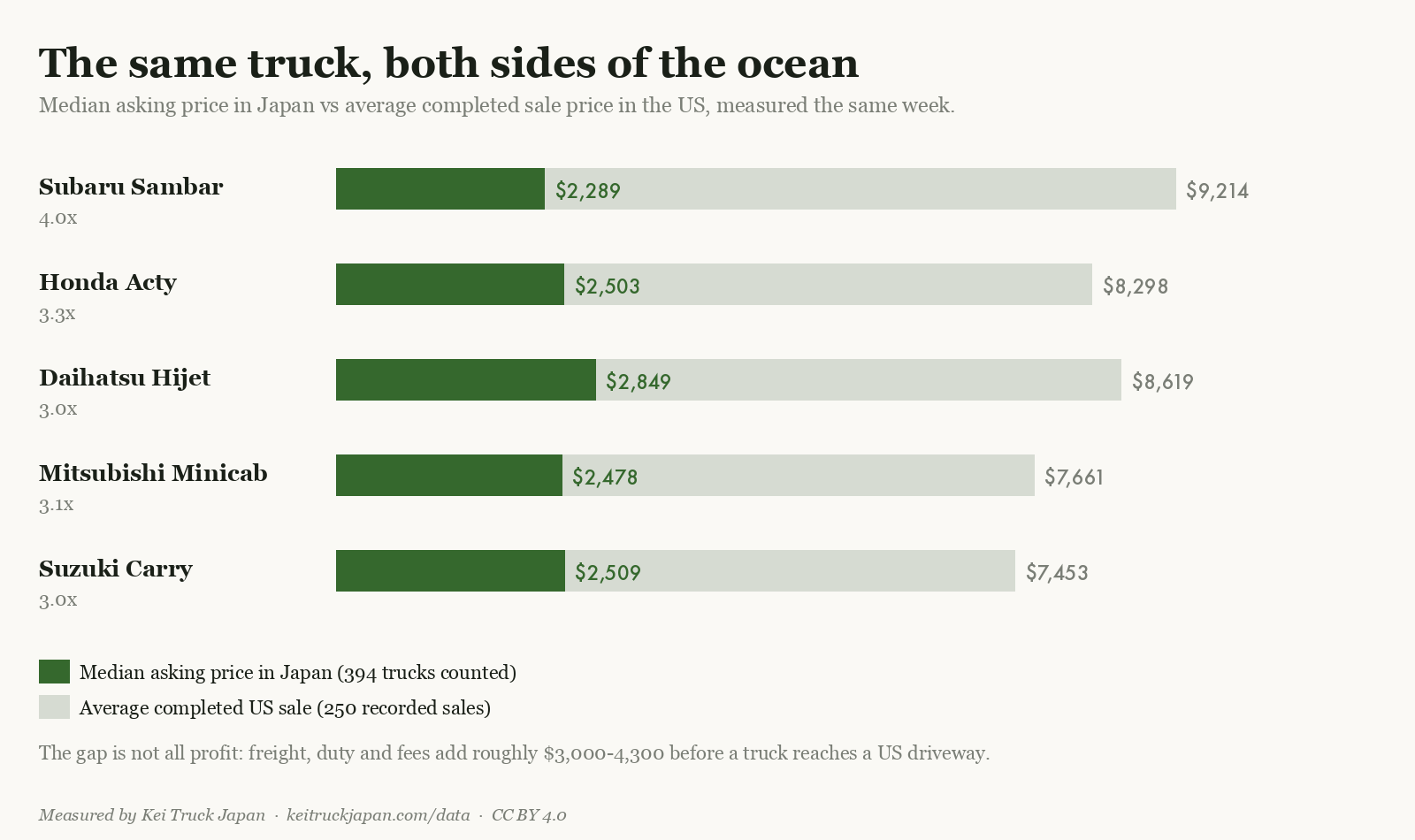
This is the table nobody else publishes, because it requires measuring both sides. Japanese figures are medians of complete public dealer inventory (yen converted at ¥159/USD); US figures are average completed sale prices, not asking prices.
| Model | Japan listings | Japan median | US average sale | Gap |
|---|---|---|---|---|
| Subaru Sambar | 81 | ¥370,000 (≈$2,327) | $9,214 (45 sales) | 4.0× |
| Honda Acty | 83 | ¥390,000 (≈$2,453) | $8,298 (78 sales) | 3.4× |
| Mitsubishi Minicab | 66 | ¥390,000 (≈$2,453) | $7,661 (25 sales) | 3.1× |
| Daihatsu Hijet | 61 | ¥450,000 (≈$2,830) | $8,619 (33 sales) | 3.0× |
| Suzuki Carry | 103 | ¥400,000 (≈$2,516) | $7,453 (69 sales)* | 3.0× |
*Classic.com tracks the Carry and its Every van sibling as one market, so the Carry’s US figure includes van sales. The Every itself has its own buyer’s guide.
Three things in this table are worth stopping on.
The Sambar is the biggest arbitrage in the class. Japanese buyers price it as the cheap old work truck it was; American buyers price it as the cult classic it has become — rear engine, available supercharger, the most car-like ride of the five. The gap between those two opinions is a 4.0× multiple, and it is the single clearest “buy in Japan, not in the US” case these numbers produce.
The Hijet’s premium is a dump-bed premium. Across all five models I recorded drivetrain for every listing, and no model shows a real 4WD price premium — for the Carry, Sambar and Minicab, 4WD medians sit within ¥15,000 of the overall figure. The Hijet at first looks like an exception (4WD median ¥490,000 against ¥450,000 overall), but decompose the listings and the story sharpens: 18 of the 61 eligible Hijets are factory dump trucks at a ¥790,000 median, 15 of those dumps are 4WD, and once dumps are set aside the remaining Hijets price at ¥380,000–390,000 with no drivetrain premium at all. What Japan actually pays extra for is the dump bed — the hardest-working configuration in the kei world, and one the Hijet dominates: it supplies more factory dumps than any price effect on any drivetrain in the class.
And step back from the per-model numbers for a second, because the table’s real message is about the whole class: a working-grade truck at these medians lands in the US for $5,500–8,000 all-in, freight and duty included (the cost guide itemizes every dollar). Even the top of that range undercuts the average sale price of three of the five models, and the middle of it undercuts all five. Importing gets you more than selection — at today’s prices it beats buying domestic almost regardless of badge.
Numbers this lopsided are the reason to buy at the source: browsing every model in this table is free at CAR FROM JAPAN, and code KEITRUCK takes $100 off a first purchase (referral link).
Supply favors the Carry. With 103 eligible trucks it has the deepest public inventory in Japan, which matters in practice: more supply means more clean, low-mileage candidates at auction in any given month, and less pressure to settle. The Hijet, at 61, is the thinnest market of the five — good trucks come up, but you wait for them.
Model by Model
Suzuki Carry — the default, and deservedly
The Carry wins the boring way: on ecosystem. Its F6A engine family is the most widely supported kei powerplant in the United States, parts interchange across a huge production run, and the US community around it is the largest of any kei truck, which means every problem you will ever have has already been photographed, diagnosed and posted by someone else. Mechanically it is the trail pick — 4WD versions came with a high-low transfer case, and rear diff locks show up frequently on the spec sheet, which is exactly the hardware you want in mud or snow. The round-headlight trucks of the 1991–1999 run (chassis codes DC51T for 2WD, DD51T for 4WD) are the ones US buyers hunt. Measured median: ¥400,000, with 4WD examples at essentially the same money — the diff-lock truck costs you nothing extra in Japan. The full Carry buyer’s guide breaks down the generations, the F6A engine facts and the Mazda Scrum backdoor.
Honda Acty — the driver’s kei truck
Honda mounted the Acty’s engine amidships, under the bed, driving the rear wheels. The result is better weight distribution than the under-cab layouts, a quieter cab, and the closest thing to car manners the class offers. Its E07A engine is simple and durable, and the newly-eligible third generation (1999 onward) is currently cheaper in Japan than the older second generation — a mispricing covered in depth in the Acty buyer’s guide, along with the Attack trim and the pre-import checklist. Measured median: ¥390,000 across 83 listings, with second-generation 4WD trucks at ¥420,000. If you care how a truck feels at 40 mph on a back road, this is the one.
Daihatsu Hijet — the workhorse
Japan’s fleets and farmers bought the Hijet to use it, and the configuration range shows it: standard beds, dump beds, deck vans, and the Jumbo cab with extra room behind the seats. Daihatsu has built it continuously since 1960, and the last eligible generations (S100/S110, then the S200/S210 series from 1999, built after Toyota took control of Daihatsu in 1998) are as simple and stout as small trucks get. It shows the highest overall median of the five (¥450,000) — though the decomposition above matters: strip out the 18 factory dump trucks and an ordinary Hijet bed costs ¥380,000–390,000, right in line with its rivals. The premium lives in the work hardware, not the badge. Thin supply (61 listings) is the main practical drawback; budget extra weeks of auction-watching to land a good one. The full Hijet buyer’s guide breaks down the dump-bed economics and the generation data.
Subaru Sambar — the enthusiast’s truck, now the value play
The Sambar hangs its engine off the back like an old 911, uses a 4-cylinder EN07 where everyone else runs a triple, and rides noticeably better than anything else in the class. Supercharged versions add enough power to make the whole thing feel deliberately engineered. US importers also make much of the EN07 being a non-interference design — if the timing belt lets go, the engine stops rather than destroys itself, a genuinely comforting property in a 25-year-old vehicle. The market facts are the headline, though: cheapest measured median in Japan at ¥370,000 (4WD the same), highest average US sale at $9,214. Nothing else in the class converts yen into dollars this efficiently. Subaru ended in-house Sambar production in 2012, so the rear-engine truck is a closed catalog — supply only shrinks from here. The full Sambar buyer’s guide covers the generations, the supercharger math and the one transmission to avoid; its van sibling, the Sambar Dias, is covered in the kei van guide.
Mitsubishi Minicab — the one nobody bids against
Almost nobody in the US talks about the Minicab, and its numbers make the case for it anyway: ¥390,000 median in Japan, $7,661 average US sale, and capability — low-range 4WD, diff locks on many examples, a usefully roomy cab — that substantially overlaps the Carry’s. The US dealers who stock it pitch it on cab space and engine output; I would pitch it on auction dynamics instead. Fewer American buyers know to bid on Minicabs, and at auction, fewer rivals is a discount. One caution from the data: my measured range ran all the way to ¥2,680,000, because restored and show-grade examples pollute the Minicab’s retail listings the same way they pollute the kei vans’. The median is honest; the extremes are not. The full Minicab buyer’s guide has the configuration-level numbers.
Which Kei Truck for Which Job?
| Your use case | Buy this | Why |
|---|---|---|
| Farm or property maintenance | Hijet (Carry close second) | Work-spec configurations, dump beds, the drivetrain Japan’s own farmers pay extra for |
| Off-road, mud, trails | Carry 4WD | Low-range transfer case + diff lock + the deepest US parts and lift-kit support |
| Snow | Carry 4WD or Sambar 4WD | Diff-lock traction (Carry) or engine weight over the driven axle (Sambar) |
| Daily/around-town driving | Acty | Best balance and cab manners in the class |
| Resale-conscious buying | Sambar or Acty | Highest US sale averages ($9,214 / $8,298) against low Japan-side cost |
| Tightest budget | Minicab or Sambar | Lowest medians, least bidding competition (Minicab) |
| Camper conversion base | None of them — buy a van | An enclosed shell beats a bed tent; start with the kei camper guide |
And if the machine you are really comparing is not another kei truck but a new side-by-side, that is a different ledger — the kei truck vs UTV comparison puts landed cost, cab, payload and road legality side by side.
Before You Bid on Any of Them
The badge decision is the fun half. The half that decides whether you get a good truck is the same for all five:
- Verify the build month, not the model year. The 25-year rule runs on the month stamped on the caution plate. A “2001” truck built in October 2001 is not importable in August 2026; one built in June is. The import guide covers how to confirm it before money moves.
- Read the auction sheet like it owes you money. Grade, underbody rust codes, and the free-text inspector notes tell you more than forty photos. The auction sheet guide decodes every symbol you will see.
- Price the whole journey. Freight, the 25% truck duty, port fees and inland transport add roughly $2,900–5,300 to whatever you pay in Japan. A cheap truck that needs a timing belt and tires is not a cheap truck.
Reliability and Parts in the US
Reliability differences between these five are smaller than the internet implies. All five are carbureted-or-simple-injection, 550–660cc commercial engines designed for decades of abuse, and at 25+ years old, the condition of the individual truck matters far more than the badge — a rust-free Minicab beats a rusty Carry every single time. That said, three structural differences are real:
- Parts availability has a ranking. Carry and Acty enjoy the deepest US supplier and community support; Hijet is close behind; Sambar and Minicab require more patience and more ordering from Japan. None are orphans, but the gap shows up when you need a body panel on a Tuesday.
- Timing-belt policy should be universal. Whatever badge you buy, assume the belt is due unless paperwork proves otherwise, and budget the job into your landed cost. The Sambar’s non-interference EN07 merely downgrades the failure from catastrophic to inconvenient.
- Rust is the real reliability spec. Every one of these trucks worked outdoors in a country that salts its roads. The underbody, bed corners and rocker seams decide the truck’s fate, and you evaluate them from the other side of the ocean through the auction sheet — here is exactly how to read one.
On power, ignore the spec-sheet war (the full specs guide has every model’s numbers). The whole class lives in a 45–50 hp band, and claims that one badge “wins” amount to a 2–3 horsepower difference you will never feel with 400 lbs of gravel aboard.
How to Import the One You Pick
Whichever truck won you over, the process is identical: verify the build date clears the 25-year rule, buy through Japan’s dealer auctions instead of the tourist-priced retail listings, and clear US customs at the 25% truck duty with the fees mapped out in advance. The step-by-step import guide covers the full sequence with the current duty math, and the exporter comparison covers who actually gets you auction access and what they charge.
If you want to put these numbers next to real inventory: CAR FROM JAPAN carries the largest English-language selection of all five trucks on this page, searchable by model, year and drivetrain. My referral code takes $100 off a first purchase — create a free account, shortlist a truck or three, enter KEITRUCK at the order step.
Compare all five kei trucks at CAR FROM JAPAN — $100 off with code KEITRUCK
You save $100; I earn a referral reward. Every price in this article is measured independently of them.
FAQ
What is the best kei truck overall?
The Suzuki Carry. It combines the largest US parts and community ecosystem with the deepest supply in Japan (103 eligible listings in my August 2026 count) and genuinely capable 4WD hardware. The Acty is the better drive and the Hijet the tougher worker, but as a single default recommendation the Carry has the fewest ways to go wrong.
How much does it cost to import a kei truck all-in?
Using the measured medians above: $2,300–2,850 for the truck in Japan, plus roughly $2,900–5,300 in freight, duty, fees and paperwork depending on port and service level — so most builds land in the $5,500–8,000 range for a solid, working-grade truck. The import guide itemizes every line.
What is the most reliable kei truck?
At 25+ years old, condition beats badge — a documented timing belt and a clean underbody predict reliability better than the logo does. Among the five, the Carry’s F6A has the deepest US parts support when something does wear out, and the Sambar’s non-interference EN07 fails most gracefully.
What is the cheapest kei truck?
In Japan, the Sambar: ¥370,000 measured median (≈$2,327), the lowest of the five. The Minicab and Acty sit close behind at ¥390,000. Remember these are Japan-side prices; add roughly $2,900–5,300 in freight, duty and fees for the landed figure, per the import guide.
What is the best kei truck for off-road use?
The Carry 4WD, for its low-range transfer case, available rear diff lock and the widest selection of US-market lift kits and tires (the off-road guide has the measured 4WD availability by model, and the mods guide covers the sensible build order). The Hijet 4WD is the strongest alternative, and if the job involves moving loose material, the Hijet’s factory dump variants are the class’s deepest pool.
Which kei truck holds its value best in the US?
By average completed sale price, the Sambar ($9,214) and Acty ($8,298) lead the class. Both pair enthusiast demand with shrinking supply — the rear-engine Sambar has been out of production since 2012.
Honda Acty or Suzuki Carry?
Carry if the truck is a tool: better parts availability, diff-lock 4WD, deepest supply. Acty if the truck is also a toy: the mid-engine layout drives better and holds value better in the US ($8,298 average sale vs the Carry market’s $7,453). Both are safe defaults; the Acty guide goes deeper on generations and trims.
Are kei trucks street legal in the US?
Federally, any truck 25 years or older imports legally without meeting modern safety and emissions standards. Registration is state law, and it ranges from plate-it-like-any-car to farm-use-only to hostile — the 50-state legality guide maps all of it, verified August 2026.
Can kei trucks drive on the highway?
Most top out around 65–70 mph and are happiest below 55. State rules differ on registration and road access, so check your DMV before buying. These are back-road and property tools; if your commute is an interstate, a kei truck is the wrong purchase.